How to verify that a crypto casino actually pays out
A step-by-step method to test a casino's withdrawals with your own money and a block explorer, plus a checklist of trust signals that are hard to fake.
"Fast payouts" is the most common promise in crypto gaming, and the hardest to check from the outside. Screenshots of big wins can be fabricated, review sites are often paid, and testimonials are worth little. The good news: with crypto, you can produce your own evidence. Every payout leaves a public, timestamped record on a blockchain.
Here is a method you can run in under an hour with a small amount of money.
Step 1: read the rules before you deposit
You want to know in advance what "normal" looks like, so you can tell when something is wrong. Find these on the casino's payments or help page:
| Question | Example of a clear answer |
|---|---|
| Minimum and maximum withdrawal | 20 USDT minimum, 5,000 USDT maximum per withdrawal |
| Who pays the network fee | Covered on TRC20; estimated and deducted on BTC |
| Review process | First withdrawals checked by staff; allow about an hour |
| Concurrency | One open withdrawal at a time |
| Where you see proof | Transaction ID shown in wallet history once sent |
The examples come from one operator's public payments page. The point is not those exact figures but that they are written down. If a site cannot tell you its limits and process before you deposit, that is your answer.
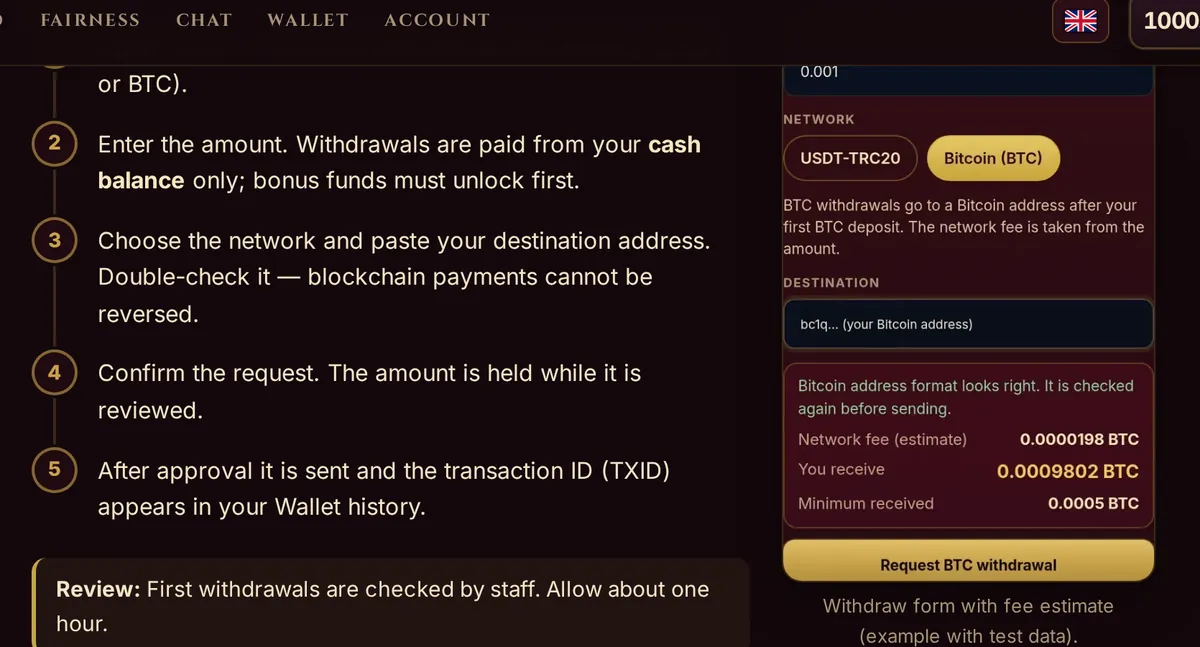
Step 2: run a small round trip
- Deposit a small amount you are comfortable losing, on the cheapest network the site supports.
- Play a few low-stake rounds, or none at all. Some sites require a minimum of play before withdrawal; read the terms so you do not trigger a bonus rule by accident.
- Request a withdrawal of at least the minimum. Note the exact time.
- Record what happens: when the status changes, when a TXID appears, any messages from support.
Step 3: verify the TXID on chain
A transaction ID is a hash that identifies one blockchain transaction. Paste it into a public explorer:
- USDT on TRON: Tronscan
- Bitcoin: mempool.space
Check four things:
- Status: confirmed, not pending or failed.
- Recipient: your address, character for character.
- Amount: what the casino said it would send, minus any fee it said it would deduct.
- Token contract for USDT: the official Tether contract on that network, not a look-alike token.
The difference between your request time and the block timestamp is the casino's real payout time for your test. Repeat once or twice over a few weeks if you plan to keep playing there.
Step 4: look for signals that are hard to fake
Some trust signals cost nothing to claim. Others are expensive or impossible to fake. Weight them accordingly.
Hard to fake - Your own successful round trip, with a TXID you checked. - Published, game-by-game RTP and a fairness system you can recompute yourself. - A clearly stated maximum win and withdrawal limit before you play. - Geo-restrictions actually enforced: a site that blocks countries where it cannot operate is giving up revenue to stay compliant. - Player-protection tools that work in your account: loss limits and self-exclusion.
Easy to fake - Win tickers and "recent big wins" feeds. Some include play-money wins; check whether practice bets are labelled. - Trust badges with no verifiable link. - Testimonials and star ratings without a way to check who wrote them.
A note on aggregate payout statistics
Some operators publish totals such as "median withdrawal time" or "withdrawals paid this month". These are useful when they come with a method and enough volume to mean something. For a new site, a handful of withdrawals, some of them internal tests, says very little. Your own test transaction is better evidence than a statistic you cannot audit.
Red flags during a withdrawal
- New conditions appear only after you request a withdrawal.
- Support asks you to deposit more to "unlock" a payout. This is a classic scam pattern.
- A TXID is promised but never appears, or points to an unrelated address.
- The site goes silent past its own stated review time without explanation.
If you see these, stop depositing, keep screenshots of every message, and do not send more funds.
Keep a simple payout log
If you play somewhere regularly, keep a small log. It takes thirty seconds per withdrawal and quickly shows whether a site's behaviour is changing. A blank template:
| Date requested | Amount | Network | Time to TXID | Confirmed on chain | Notes |
|---|---|---|---|---|---|
Over a few months this becomes far more useful than any review: you will see your own median payout time, whether reviews get slower, and whether amounts ever differ from what was promised.
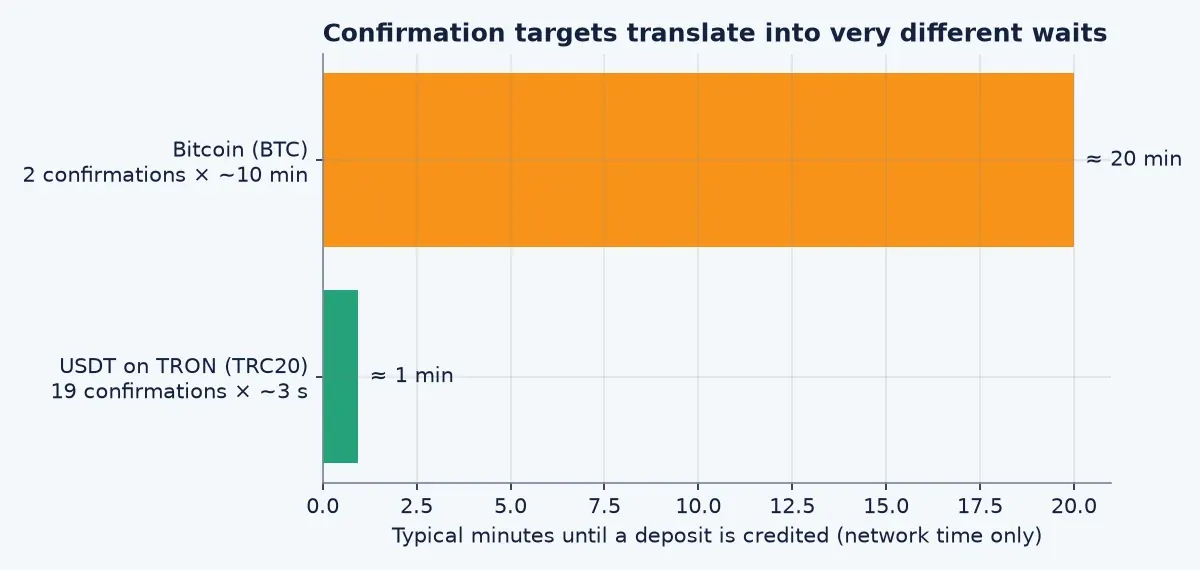
A note on screenshots and "payout proofs"
Screenshots of large wins or withdrawals are easy to fake and impossible to verify. A transaction ID is different: anyone can look it up on a public explorer and see the amount, time and confirmations. If a site or promoter shows payout "proof" without a checkable TXID, treat it as marketing, not evidence.
FAQ
Is a review delay on the first withdrawal a bad sign?
No. Manual review of first withdrawals is a common anti-fraud step. What matters is that it is disclosed and roughly matches the stated time.
Can I verify payouts to other people?
Not reliably. You cannot know which addresses belong to which players. Verify your own.
Does provably fair mean the casino pays?
No. It proves results were not changed after you bet. Payment is a separate question that only withdrawals answer.
18+ only. Never deposit more to unlock a withdrawal.